Biobased & Circular economy
—8 september 2026
September 8, 2026
3 minutes

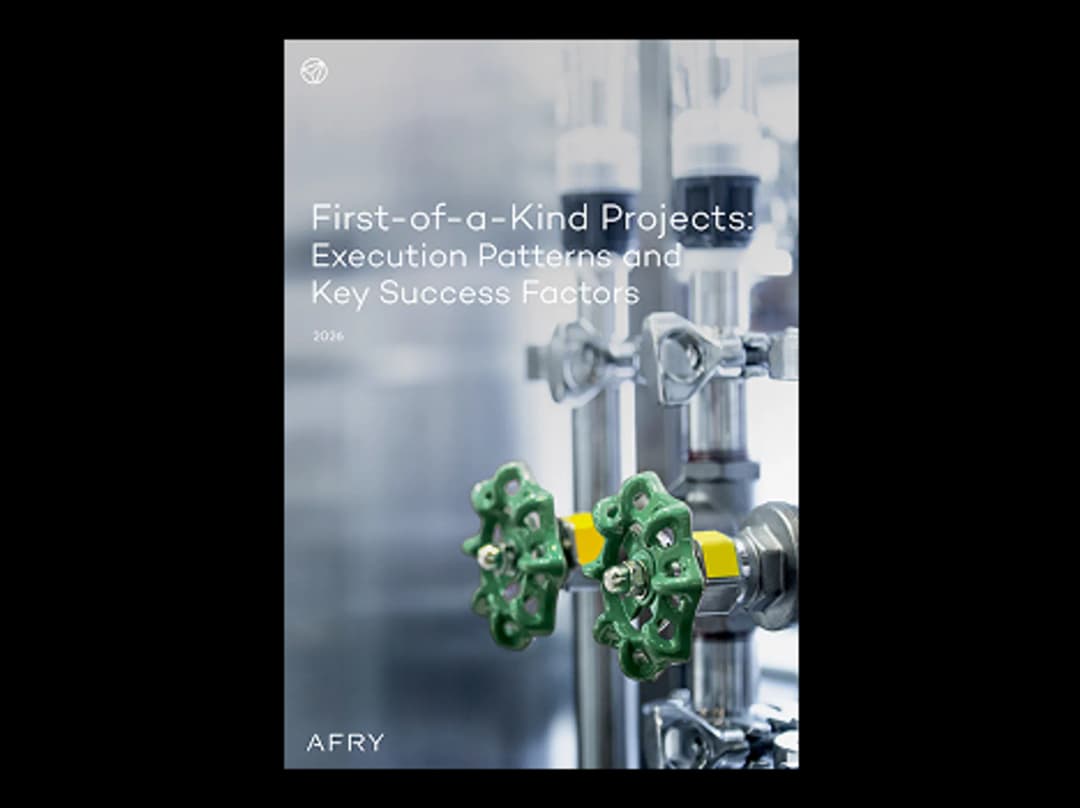
The step from proven technology to the first commercial plant is a major financing bottleneck for many innovative companies. Invest-NL, together with AFRY Management Consulting, has published new research into First-of-a-Kind projects, showing that risks and lead times at this stage are systematically underestimated. The report brings together practical lessons from 30 industrial projects and shows what is needed to successfully scale up innovative technology.
Many technologies for the energy and materials transition have moved beyond the pilot phase. Yet the step towards the first commercial plant often remains difficult. In this First-of-a-Kind phase, investments are substantial, while technology, market, execution and regulatory conditions are still uncertain.
That is precisely why practical lessons matter. Invest-NL, together with AFRY Management Consulting, is publishing a study on FOAK projects. For the report, 30 industrial projects in 13 countries were analysed. The researchers also spoke to 16 FOAK developers, EPC contractors and legal experts.
One important lesson is that FOAK projects are not only a technological challenge, but above all an execution challenge. Many plants ultimately function technically, but nevertheless fail to achieve their original business case. The report shows that this is often due to overly optimistic assumptions about ramp-up, costs and commercialisation.
The report identifies four important lessons:
FOAK projects require strong execution. This means that planning, costs, permits, offtake agreements, team capacity and collaboration need to be well organised from the outset.
Success is a shared responsibility. Developers, investors, project teams and policymakers must remain well aligned throughout the project.
Business cases are often too optimistic about ramp-up. For example, 48% of the projects studied experienced a ramp-up that took 12 to 36 months longer than initially assumed. This means higher costs and a longer period before the plant generates revenue at full capacity.
Strong operational knowledge within the company itself is an important predictor of success. Companies that possess this knowledge in-house can identify problems earlier and adjust more effectively during construction, start-up and scale-up.
Reality calls for realistic expectations and effective collaboration. Companies need to take longer start-up periods, higher costs and dependencies between technology, permits, the market and the organisation into account. Investors need financing structures that reflect this uncertainty, with sufficient buffers, clear milestones and room to adjust course.
Through this study, Invest-NL aims to make lessons from previous FOAK projects accessible to entrepreneurs, financiers and government. This will create a shared knowledge base for better understanding, assessing and allocating risks.
Invest-NL uses the insights from the report in discussions with FOAK companies, investors and policymakers. The aim is to learn from practical experience together and make future FOAK projects easier to finance and execute. This can help innovative technologies progress more quickly from promise to industrial impact.
Marjella de Vries
sr. investment manager