Biobased & Circular economy
—17 februari 2026
February 17, 2026
3 minutes
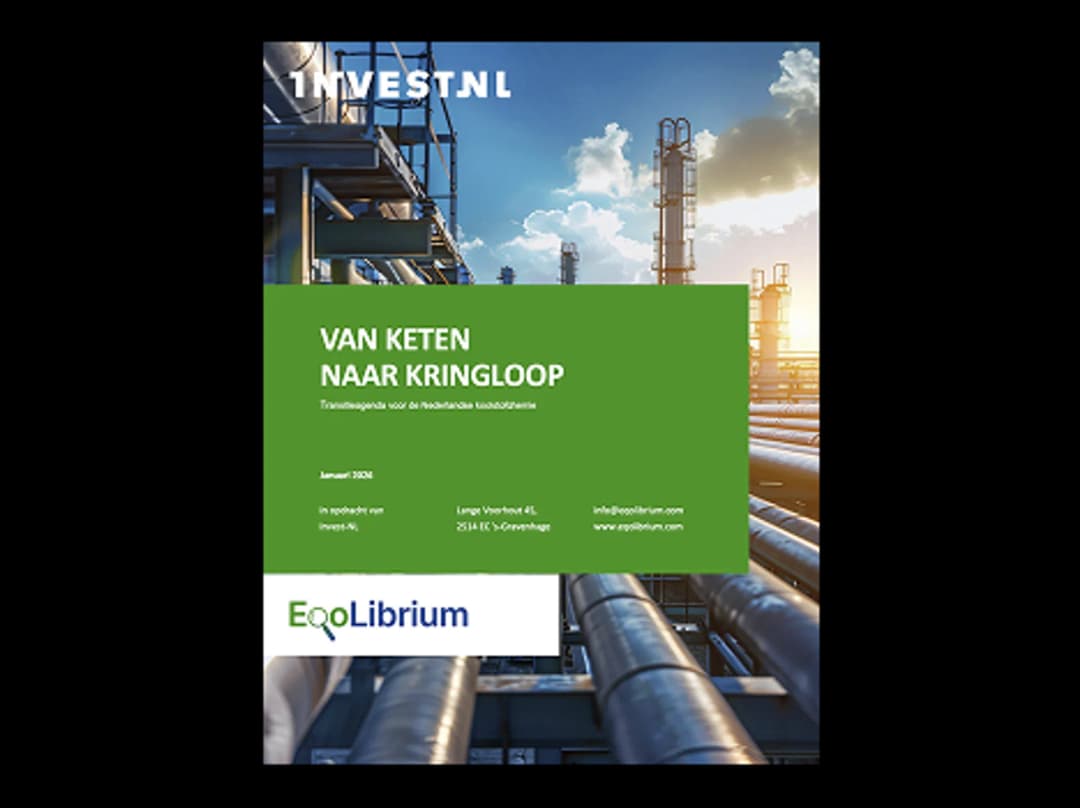
The Dutch chemical sector is facing a major shift. How do we ensure that the production of plastics and other carbon products remains both circular and competitive by 2050? In the report from chain to cycle, Invest-NL outlines which technological pathways are possible, what choices need to be made, and what this demands from policy.
Carbon is essential for products such as plastics, building materials, and high-end materials. Currently, that carbon mostly comes from oil and gas. If the Netherlands wants to be climate-neutral by 2050, this fossil carbon must be gradually replaced by recycled streams, bio-based resources, and carbon from CO₂.
On behalf of Invest-NL, Eqolibrium investigated which routes are most promising and what role Invest-NL can play in this. The scenario analysis helps to make targeted investment choices and to engage in discussions with government, industry, and other financiers about the necessary conditions.
The report has developed three scenarios for the development of Dutch carbon chemistry towards 2050. They show that different pathways are possible, with varying mixes of, for example:
Business as usual policy assumes continuation of current national and European policies without additional measures
Profitability (net-zero with a level playing field) aims to achieve net-zero emissions by 2050 and maintain a competitive Dutch industry
Maximum circularity (fossil-free circular economy) strives for a fully fossil-free and circular economy by 2050 (going beyond net-zero)
The scenarios demonstrate how current choices impact production capacity, emissions, costs, raw material use, and competitiveness in the future. This creates a more realistic picture of what is needed to make the transition.
The study results in several clear recommendations for policy and implementation. For example:
Accelerate investments in high-quality recycling (mechanical and chemical) to increase both volume and quality of recyclate.
Prioritize biogenic routes with the highest system value: use the technology ranking as a framework for assessment, and avoid using scarce biomass for low-value or easily electrifiable applications.
Accelerate investments in energy infrastructure (electricity and hydrogen): without timely expansion, even attractive routes lose their investability; infrastructure acts as a lever for the entire transition.
These points can only be addressed in an integrated manner. Therefore, close collaboration between government, regions, companies, and financiers is essential.
Invest-NL aims to work together with partners on developing a carbon chemistry that meets climate goals, preserves jobs, and attracts new businesses. The report from chain to cycle is an invitation to take concrete steps together now.
Xandra Weinbeck
sr. business development manager